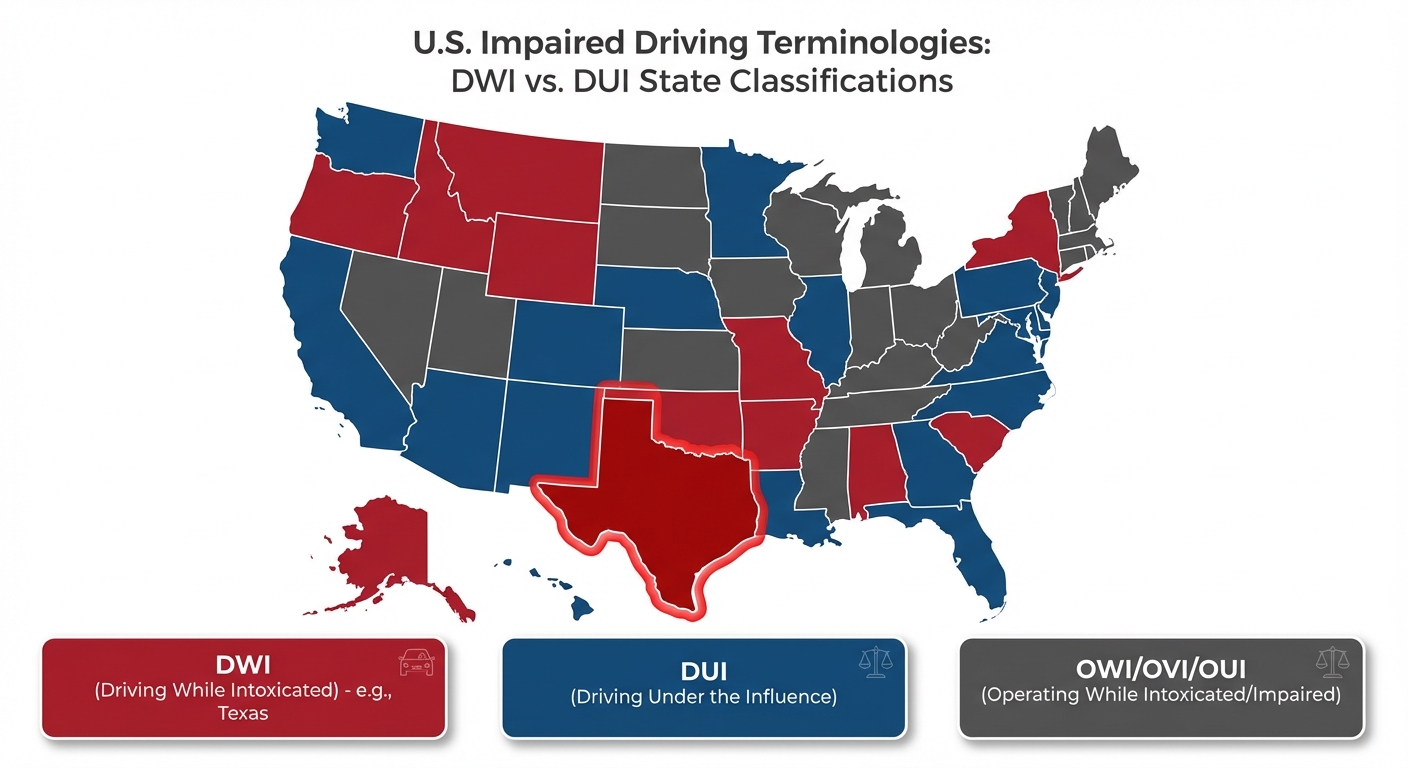
Map of the acronyms: what states use DWI instead of DUI, and where Texas fits into that patchwork of drunk driving laws?
The short answer to what states use DWI instead of DUI is that a handful of states primarily use DWI, including Texas, New York, North Carolina, Louisiana, Arkansas, Missouri, Minnesota, New Mexico, New Jersey, and New Hampshire. Most other states use DUI or a close cousin like OWI, OUI, OVI, or DUII, and a few use both DWI and DUI type labels for different levels or versions of the offense. This matters when you cross state lines because the word on your paperwork can change, but the consequences can still follow you.
If you work in Houston and travel for projects, the label on a stop or charge can feel like alphabet soup. Below is a plain, map-style list of DWI states vs DUI states and how Texas sits in that mix. We will also explain how records and license actions can travel, plus simple steps to protect your job and driving privileges right now.
What states use DWI instead of DUI, and how the rest label drunk driving
Mike, if you are trying to figure out what a Louisiana DWI means back home in Texas, you are not alone. Use this quick reference to see which states lean on DWI, which use DUI, and which use related acronyms. Labels can change over time, and each statute defines its own terms, so treat this as a practical map, not a final legal citation.
DWI states vs DUI states list at a glance
| Category | States | Notes |
|---|---|---|
| Primary DWI states | Texas, New York, North Carolina, Louisiana, Arkansas, Missouri, Minnesota, New Mexico, New Jersey, New Hampshire | These states typically charge the adult offense as DWI, even if they also have related terms for specific situations. |
| Mixed or dual-label states | Maryland, Colorado | Use more than one label by statute or practice. For example, Maryland uses DUI and DWI tiers. Colorado uses DUI and DWAI. |
| Common DUI states | Alabama, Alaska, Arizona, California, Connecticut, Delaware, District of Columbia, Florida, Georgia, Hawaii, Idaho, Illinois, Kansas, Kentucky, Mississippi, Montana, Nebraska, Nevada, North Dakota, Pennsylvania, Rhode Island, South Carolina, South Dakota, Tennessee, Utah, Vermont, Virginia, Washington, West Virginia, Wyoming | These jurisdictions commonly use DUI as the primary label, even if the statute text varies. |
| Other acronyms |
OWI: Iowa, Michigan, Indiana, Wisconsin OVI: Ohio OUI: Maine, Massachusetts DUII: Oregon |
Different letters, same basic concept. Each state defines the offense in its own way. |
If you are a Houston driver, the key takeaway is simple. Texas is a DWI state for adults, while neighboring Louisiana and New Mexico are also DWI states. Drive a few hours east into Mississippi and you will see DUI. Fly to Ohio and the paperwork says OVI. The words change at the border, but the decisions you make after a stop carry real consequences wherever you go.
Texas as a DWI state, and how the term appears on records
Texas labels the adult offense as DWI, while the term DUI exists in Texas law for certain underage cases. If you need a deeper overview, this page can explain how Texas defines a DWI and how records look. In practical terms, that means an adult arrest in Harris County will show up as DWI on most public and employer background checks, even though other states might call the conduct DUI or OWI.
For the PrimaryPersona Mike, that label matters because background screeners and HR software often index the exact charge name. A Houston construction manager who travels to Louisiana or New Mexico can end up answering questions that sound the same but use different letters. The offense type is what counts in court, but the letters on the page can affect perception with a boss or a client.
In Texas, common record touchpoints include the criminal case and a separate administrative license action. A first DWI arrest can trigger an Administrative License Revocation process with possible suspension starting at 90 days if there is an alcohol test failure, and 180 days if there is a refusal. Those numbers can increase with prior alcohol contacts. The administrative clock often starts immediately at the stop, which is why the 15 day request window below is so important.
Why the acronym does not always equal severity
Many people assume DWI is always worse than DUI. That is a misconception. In Texas, DWI is the standard adult charge, and severity depends on factors like prior history, alleged blood alcohol concentration, the presence of a child passenger, or an accident. In Maryland, DUI is the higher tier and DWI is the lower tier. The label does not tell the whole story. The statute does.
For a deeper Texas specific breakdown of how everyday language can mislead, see this short explainer on why Texas uses DWI and what that means.
Terminology differences in drunk driving laws, with simple border examples
Here are three plain routes a Houston driver might take, with what the paperwork usually says in each place.
- I 10 west, Houston to New Mexico: Texas is DWI, and New Mexico is DWI.
- I 10 east, Houston to Mississippi: Texas is DWI, Mississippi is DUI.
- Direct flight to Ohio: Texas is DWI, Ohio is OVI.
Mike, these are not just roadside words. If you get stopped on a work trip, the acronym on the citation can affect how the case is coded in court software, how it is reported back to Texas, and how an employer sees it in a background report. If your job involves safety sensitive duties, you may have to report a license action even if your criminal case is still pending.
Micro story: a Monday morning question no one wants
“I just wrapped a weekend site walk in Baton Rouge, got stopped on the way back, and the paper says DWI. I thought Texas was the only place that used those letters. Is this going to mess up my Houston license and my project start on Tuesday” That is a real life type of Monday morning phone call from a mid career manager. The answer is that the acronym can differ by state, yet the event may still reach your Texas driving record. Early steps in the first 15 days make a difference.
How a Texas DWI can show up on background checks and across state lines
Three systems matter for most Houston professionals who travel.
- Criminal case record: The county where the arrest happens holds the criminal case. A Texas adult case shows as DWI. In other states the “same” behavior can show as DUI, OVI, or OWI. Employers and licensing boards often look at the case disposition, not just the acronym.
- Administrative license action: In Texas, a DWI arrest can trigger an Administrative License Revocation process, separate from the criminal case. The hearing request deadline is short, and missing it can suspend your driving privileges by default.
- Interstate reporting: Most states share information from license actions and convictions. The label can change in translation, but the system usually recognizes the offense category. That is why a DUI in another state can still prompt questions on a Texas job form, and a Texas DWI can show up in a national background screen.
If you are a Career First Professional, remember that discretion helps. It is better to know what is in your record before HR asks. A quick pull of your Texas driver record and a precise calendar of deadlines can minimize surprises.
For a nuance heavy view of terms, penalties, and stigma in Texas practice, this guide explains how DWI and DUI labels differ in practice and impact.
Traveling between DWI and DUI states, and what to do in the first 15 days
Here is a short, job safe checklist you can use right away if you were stopped in Houston or anywhere in Texas. The goal is to protect your license first, then organize the criminal case. If your stop happened out of state, adapt the list and ask a qualified Texas DWI lawyer how Texas deadlines apply to your driver’s license.
- Mark the 15 day ALR deadline: In Texas, you typically have 15 days from receiving the suspension notice to request a hearing. Use the official portal to confirm details and submit your request. Here is the Official DPS ALR hearing request and deadline portal.
- Read the paperwork label: Your citation or warning may say DWI, DUI, OWI, OVI, or something similar. Write down the exact words and the statute number. If your stop occurred in Texas, adults usually see DWI on the paperwork.
- Note any test or refusal: Implied consent rules apply in Texas. Refusal can lead to a longer administrative suspension than a test failure, which is one reason the hearing matters. You can review the statute text here, in the Texas statute on implied consent and test refusal consequences.
- Calendar your work obligations: Let travel coordinators or safety officers know you have a legal appointment on specific dates if needed. You do not need to overshare labels, just handle the schedule conflicts.
- Ask a Texas based lawyer how the label translates: The letters on the ticket do not control what Texas DPS does with your license, but they are a useful starting point. A short consult can clarify next steps.
If you want a single page overview of the deadline mechanics, this resource covers how to check the 15 day ALR deadline and how to request a hearing.
Key definitions that help you compare across states
It is easy to get lost in the acronyms. These quick definitions can keep you oriented.
- DWI: Often short for Driving While Intoxicated or Driving While Impaired. In Texas it is the adult offense label.
- DUI: Often short for Driving Under the Influence. In Texas, DUI typically applies to drivers under 21 in certain circumstances.
- DWAI: Driving While Ability Impaired. Used in Colorado as a related but distinct offense from DUI.
- OWI, OVI, OUI, DUII: Different states use these terms for similar conduct. The proof and penalties depend on each state’s statute.
- Implied consent: The rule that refusing a breath or blood test can trigger an administrative license penalty, separate from the criminal case. See the Texas statute linked above for the current text.
Mike, two things from this list matter most at work. First, the label on your case file can shape how HR reads a background report, even when two states are talking about the same conduct. Second, the administrative side of a DWI can hit your ability to drive long before the criminal case is finished. That is why early organization helps.
Secondary reader notes for different goals
Analytic Planner (Ryan/Daniel): You want clean lists and rules. Use the table above to categorize by term, then look at each statute’s elements. If you compare outcomes, line up the offense level, prior history, any 0.15 or higher allegation, and whether a child passenger was alleged. Those variables change the penalty grid, not just the acronym.
Career First Professional (Sophia/Jason): Your priority is discretion and continuity. Calendar the 15 day hearing request and keep a simple log of dates, screenshots of submissions, and copies of paperwork. If you must self report to a licensing board, prepare a factual summary that uses neutral language and cites the statute, not a headline word.
Tech Savvy Exec (Marcus/Chris): You care about how data flows. Expect separate data streams, one from the court and one from DPS or the out of state DMV. National background vendors and insurance carriers read both. Early hearing requests and later record sealing options can change what shows up in those feeds over time.
Unaware Nightlife Crowd (Tyler/Kevin): The letters look like semantics until they cost you a license, a job site, or a flight. Different state, different letters, same stake. A suspended license can mean no paycheck if you drive for work.
Houston context, courts, and timelines in plain English
In Harris County, a first time adult DWI is commonly filed as a misdemeanor, and settings are scheduled on a timeline that is weeks or months long. You can be dealing with the administrative license side within days, and those two tracks do not always move together. Surrounding counties run similar timelines with small differences in procedure and docket settings.
Mike, this is where practical planning helps. If you know you have a site mobilization date, make sure the license hearing, any interlock installation, and court dates are on your calendar now. Reworking a project crew at the last minute can be more expensive than a few hours of early preparation.
Records, sealing, and long term impact
The label on the charge is only part of your future. The final disposition matters most for long term record checks. Dismissals or not guilty outcomes can open the door to record sealing remedies, and certain types of orders can reduce what shows up on common background reports. The naming convention in another state does not control Texas sealing rules, yet it can affect how a commercial database displays your entry. If a screen shows DWI in Texas and DUI in another state for separate events, that can read worse than it is unless you can point to the exact outcomes.
Common misconceptions about DWI and DUI labels, corrected
- Misconception: DWI is always worse than DUI. Correction: Severity depends on the statute, the evidence, and your history. In Texas, DWI is the adult label and can be a misdemeanor or a felony depending on facts.
- Misconception: If your out of state ticket says DUI, Texas will ignore it. Correction: Information often flows back through administrative and court channels. The letters can change in translation, but the event can still appear in Texas systems.
- Misconception: You have plenty of time to deal with your license. Correction: The ALR request window in Texas is short, usually 15 days from notice, and missing it can lead to a default suspension.
Frequently asked questions about what states use DWI instead of DUI
Which states near Texas use DWI instead of DUI
Louisiana and New Mexico both use DWI as the primary term, like Texas. Mississippi, just to the east of Louisiana, commonly uses DUI. That is why you might see DWI on one trip and DUI on the next, even when the conduct is similar.
How long does a DWI stay on my record in Texas
There is no automatic drop off for a Texas DWI. Case outcomes and later record sealing options control what future background checks show. If a case is dismissed or you are found not guilty, you may have options to limit access to records under Texas procedures.
Does Texas treat an out of state DUI like a Texas DWI
Texas looks at the underlying event and the type of offense, not just the letters. An out of state DUI can lead to Texas license consequences depending on the facts and how information is reported. The administrative timeline can move faster than the criminal case, so track both.
What happens if I refuse a breath or blood test in Houston
Refusal can trigger a longer administrative license suspension than a test failure. You usually have 15 days from notice to request a hearing on that suspension. See the DPS portal link above for submission details and deadlines.
Is a Texas DUI the same thing as DWI
Not for adults. In Texas, DWI is the typical adult charge, while DUI is usually reserved for certain underage cases. Other states flip that, using DUI for adults and no DWI at all.
Why acting early matters if you work in Houston
If you manage crews or drive company trucks, days off the road are expensive. Early steps help you protect your license window, set realistic expectations with your team, and avoid avoidable defaults. A short, focused plan in the first 15 days can save weeks of disruption later.
Mike, your goal is to keep work moving while you deal with the legal process. Mark your deadlines, keep copies of every submission, and consider speaking with a qualified Texas DWI lawyer about how the out of state label translates to Texas systems. Clear information lowers risk.
A quick video if you want the short version: This two minute explainer walks through how Texas uses DWI for adults and how that differs from DUI in other places. It is a fast way to get clarity on the label before you dive into the details below.
Resources: For location context if you plan to visit in person for general Houston based DWI resources, see the Butler Law Firm location and map for Houston based resources. As a reminder, this article is educational and not a promise of any outcome. For definitions and Texas procedures, see the internal and statutory links above.
Butler Law Firm - The Houston DWI Lawyer
11500 Northwest Fwy #400, Houston, TX 77092
https://www.thehoustondwilawyer.com/
+1 713-236-8744
RGFH+6F Central Northwest, Houston, TX
View on Google Maps


No comments:
Post a Comment